Abstract
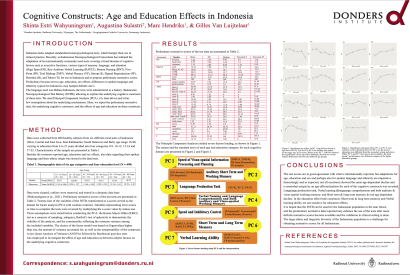
Neuropsychological tests are sensitive tools for measuring cognitive abilities, and they refer to the Assessment of healthy persons and various categories of patients. Some cognitive abilities are influenced by age and education, and some are not. Recently, ten neuropsychology tests were adapted for Indonesia, forming the Indonesian Neuropsychological Test Battery (INTB). It is the first neuropsychological test battery administered in Bahasa, Indonesia. This study presents preliminary normative scores, test-retest reliability, and the effects of age and education on each test. Data from four hundred and ninety healthy participants from Java (Jakarta, Semarang, and Surabaya), stored in a dynamic database (Indonesian-ANDI), were used. Preliminary normative scores of INTB are presented. All tests showed a moderate to good test-retest correlation coefficient ranging from 0.51 to 0.84, and an exception was the short and long-term recall scores of the RAVLT. Analysis of variance revealed that eighteen subtests were significantly age-dependent, and the scores tended to decline with the ageing process. Only the time to complete the Bourdon and RAVLT learning over trials did not decrease. In contrast, cognitive performance was increased along with a higher education level. The only exceptions were the time to complete the Bourdon and the RAVLT's learning over trials and delayed recall. These different effects of age and education on the tests of the INTB demonstrate the necessity to correct the normative score of the tests in a tailored way for these factors.