Cognitive Constructs: Age and Education Effects in Indonesia
Introduction:
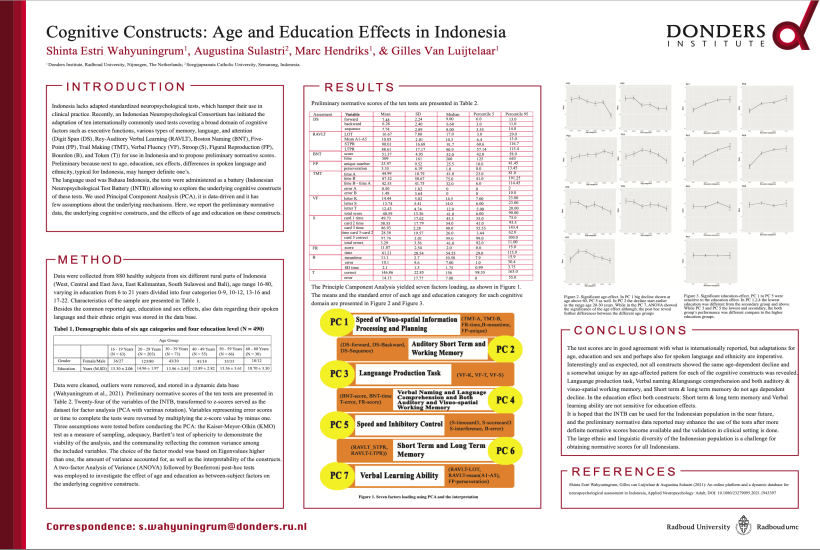
Indonesia lacks adapted standardized neuropsychological tests, which hamper their use in clinical practice. Recently, an Indonesian Neuropsychological Consortium has initiated the adaptation of ten internationally commonly used tests covering a broad domain of cognitive factors such as executive functions, various types of memory, language, and attention
(Digit Span (DS), Rey-Auditory Verbal Learning (RAVLT), Boston Naming (BNT), Five- Point (FP), Trail Making (TMT), Verbal Fluency (VF), Stroop (S), Figural Reproduction (FP), Bourdon (B), and Token (T)) for use in Indonesia and to propose preliminary normative scores. Preliminary because next to age, education, sex effects, differences in spoken language and ethnicity, typical for Indonesia, may hamper definite one’s.
The language used was Bahasa Indonesia, the tests were administered as a battery (Indonesian Neuropsychological Test Battery (INTB)) allowing to explore the underlying cognitive constructs of these tests. We used Principal Component Analysis (PCA), it is data-driven and it has
few assumptions about the underlying mechanisms. Here, we report the preliminary normative data, the underlying cognitive constructs, and the effects of age and education on these constructs.